Why Teterboro has a weight limit, and what it means
Teterboro does not accept every aircraft at every weight. For most travelers the rule is invisible. For a few long trips in the biggest jets it shapes the plan. Here is how it works.
The rule, simply put
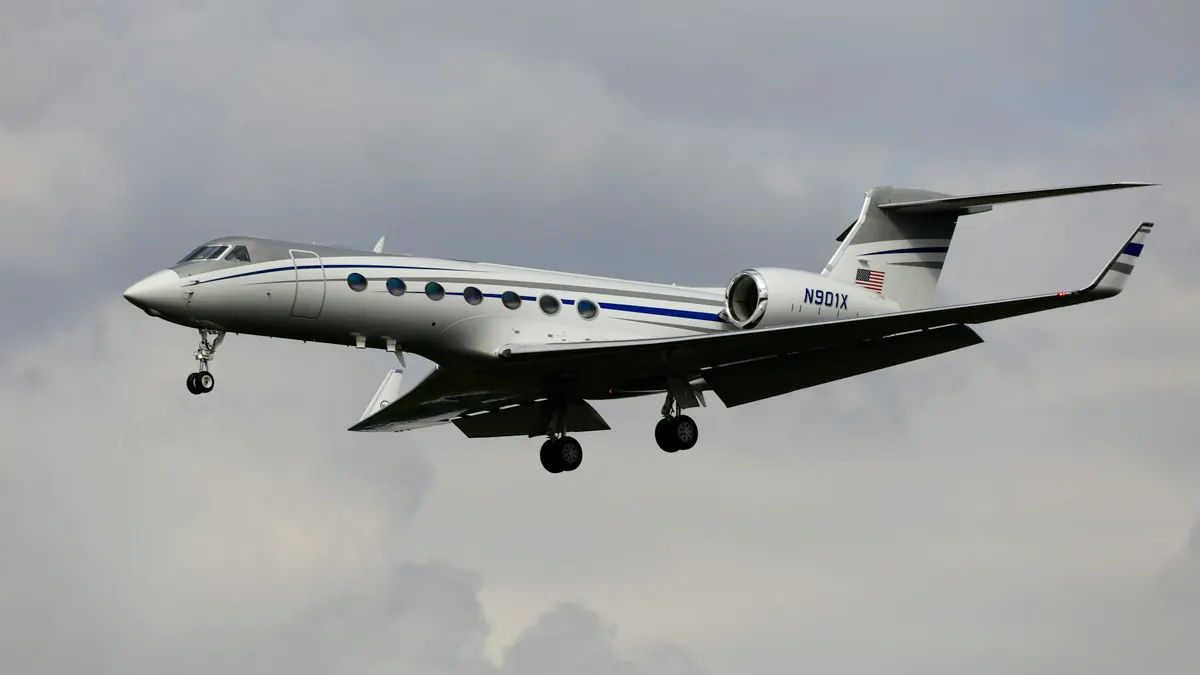
Teterboro's operator, the Port Authority of New York and New Jersey, sets a maximum weight for aircraft using the airport. The figure usually cited is around 100,000 pounds of maximum takeoff weight; operators check the current rules for each flight. Aircraft above the limit cannot use Teterboro as normal.
For context, that ceiling sits far above the weight of light, midsize and super-midsize jets, and above most large-cabin jets too. It sits below airliners of every size, which is one reason Teterboro has no airline service. The aircraft that come close to it are the biggest ultra long range business jets.
Why it exists
Teterboro is a small airport in a crowded place. Homes, offices, highways and wetlands sit close around it, and its runways were never designed for the heaviest aircraft. A weight limit is a straightforward way to match the traffic to the airport: it protects the runways and the surroundings, keeps large aircraft at airports built for them, and helps manage noise in the neighborhoods around the field.
The limit is not a judgment about safety of any particular aircraft. It is about what this airport, in this location, is meant to handle.
Who it affects, and when
The key word is maximum. An aircraft's weight on any given day depends on what it carries: passengers, bags and, above all, fuel. Fuel is heavy, and long trips need a lot of it. That is why the same jet can be comfortably legal for a flight to Florida and problematic for a flight to the Gulf.
| Category | Typical TEB trips | Effect of the limit |
|---|---|---|
| Turboprop to midsize | Hamptons, Florida, Chicago | None in practice |
| Super-midsize | Aspen, Los Angeles, Las Vegas | None in practice |
| Large cabin | London, Paris, Geneva | Rarely a factor for most types |
| Ultra long range | The Gulf, Asia, South America | Can matter when fully fuelled for very long flights |
So the people who notice the limit are typically those flying the largest long-range jets on the longest routes, such as New York to Dubai or to Asia, where the aircraft wants every pound of fuel it can carry.
How operators plan around it
When a trip runs into the limit, there are well-worn solutions. Your advisor and the operator weigh them for time, comfort and cost.
- Depart lighter and stop. The aircraft leaves Teterboro with less fuel and makes a short fuel stop on the way. You keep the convenience of Teterboro at the cost of a little time.
- Use a different airport. Westchester County Airport and the region's larger airports handle the heaviest business jets. If your car starts in Westchester or Connecticut, this can even be the shorter drive.
- Choose a different aircraft. A large-cabin jet with slightly less range may be able to make the trip, or make it with one stop, while staying well inside the limit.
- Split the trip. For multi-city itineraries, ordering the legs differently can put the longest leg somewhere else.
None of these is unusual. Operators that fly from New York every day plan around the limit as a matter of routine.
A worked example
Consider a group of twelve flying from New York to Dubai in an ultra long range jet. The route is long enough that the aircraft would like to leave with full tanks, which takes it close to, or above, Teterboro's limit. There are three sensible plans.
The first is to depart from Westchester, which accepts the aircraft at full weight, and fly nonstop. For travelers starting in the northern suburbs this is often the easiest choice. The second is to depart from Teterboro with less fuel and make a short stop in Europe to top up, adding a little time but keeping the Manhattan departure. The third is a large-cabin jet with a planned fuel stop, which may cost less and still arrive the same day. Your advisor sets out all three with times and prices so you can decide.
Why not use one of the big airports?
JFK and Newark accept the heaviest aircraft, and private flights do use them. The trade-off is airline traffic: longer taxi times, busier airspace and terminals designed for airlines rather than private passengers. For most private travelers, Westchester offers the same freedom on weight with a far simpler experience, which is why it is usually the first alternative we suggest.
Questions worth asking
- Does this aircraft need to depart below its maximum weight for this route?
- If so, where would the fuel stop be, and how long would it add?
- What would the same trip look like from Westchester?
- Is there a large-cabin alternative that avoids the issue altogether?
What it means for your quote
If your trip uses one of the largest aircraft on a long route, your quote will reflect the plan: a fuel stop appears in the timing, a different departure airport appears in the itinerary, or a different aircraft appears as an option. We will explain why. For the great majority of trips, from a Hamptons hop to a transatlantic flight in a large-cabin jet, the limit never comes up at all.
Coming back to Teterboro
The limit applies to arrivals as well as departures, but the numbers work differently. An aircraft landing after a long flight has burned most of its fuel and is far lighter than when it took off. That is why a long-range jet that could not leave Teterboro fully fuelled can often land there at the end of a long trip without difficulty. The operator checks both directions when planning the round trip.
The other airports' rules
Every airport has its own rules, and Teterboro's weight limit is just one of them. Westchester has overnight quiet hours. Smaller fields in the Hamptons, the mountains and the Riviera restrict size, hours or both. Part of an advisor's job is knowing these rules so that the plan you approve is one that works on the day.
In one paragraph
Teterboro caps aircraft weight to suit a small airport in a dense neighborhood. Light to large-cabin jets fly normally. The heaviest long-range jets on the longest trips may need a fuel stop, another airport or another aircraft, and your quote will show which.
Planning a long-range trip?
Tell us the destination and group size. We will propose the aircraft and departure field that make sense, weight limit included.
Get a quote